


The telegram carried only two words: “Saved alone.” Anna Spafford sent it from Wales to her husband in Chicago, days after the ship on which she was traveling with her four daughters sank in the middle of the Atlantic in barely twelve minutes. Anna had survived; the girls had not. Millions of believers have since sung the chorus of this hymn, “It is well, it is well with my soul,” at funerals, vigils, and moments of brokenness, often without knowing where so much peace came from. What almost nobody knows is that those words were not born in a time of plenty, but on the deck of a ship, over the cold waters of the Atlantic, very near the place where a father had lost his four daughters just weeks before. This is the true story of Horatio Spafford, the man who lost almost everything and, even so, could say to his soul: it is well.
A prosperous man, a city in flames
Horatio Gates Spafford was a well-known Chicago lawyer, senior partner of an important firm, a believer committed to his church, and a close friend of the evangelist Dwight L. Moody. Like many businessmen of his time, he had invested much of his fortune in properties on the city’s north side, which kept on growing. But in October 1871, the Great Chicago Fire reduced the city to ashes and almost completely destroyed Spafford’s investment.
It was not the family’s only wound: the Spaffords had already endured the pain of losing their young son, barely four years old, to scarlet fever. Even so, they pressed on, supporting the work of the church and rebuilding their life step by step. In 1873, two years after the fire, they decided to take a trip to Europe: a needed rest for the family and, at the same time, the opportunity to accompany Moody, who in those months was preaching in England.
They went ahead
Everything was planned for them to travel together, but at the last hour urgent business matters — problems arising from the fire — kept Horatio in Chicago. Far from canceling the trip, the family made a decision that seemed harmless: Anna, his wife, and the four daughters would go ahead, and he would catch up a few days later.
And so Anna Spafford boarded with Annie, Maggie, Bessie, and little Tanetta, aged between twelve and two, aboard the French steamer Ville du Havre, heading for Europe. Father and daughters said goodbye with the excitement of reuniting soon, never imagining that this farewell would be the last. Horatio took up his business in Chicago and they set course for the Atlantic, trusting, like any family setting out on a long-awaited vacation.
Twelve minutes in the Atlantic
In the early morning of November 22, 1873, in the middle of the ocean, the Ville du Havre collided with the Loch Earn, a British iron-hulled sailing ship. The impact was devastating: the French steamer broke apart and sank in barely twelve minutes, amid the darkness and the desperation of passengers seeking how to save themselves.
Of the 313 people traveling on board, 226 lost their lives. Among them were the Spaffords’ four daughters. Anna was one of the few survivors: she was rescued alive, clinging to wreckage of the ship that floated on the water. The survivors were taken to Cardiff, in Wales, where the mother faced the hardest news: she was alive, but she was returning alone. In a few hours, the sea had snatched her four daughters from her.
Two words by telegram
From Cardiff, Anna sent her husband a brief telegram that would become famous in the history of Christian music. The message, in English, said only: “Saved alone.”
Two words, and everything fit in them. She lived; her four daughters did not. Upon receiving the telegram in Chicago, Horatio wasted no time: he took the first available ship bound for Europe to reunite with his wife and embrace her amid the grief. Perhaps he thought the journey would be only that, a passage of pain. But God had prepared on that crossing the moment that would give birth to one of the church’s most beloved songs.
A poem over the waters
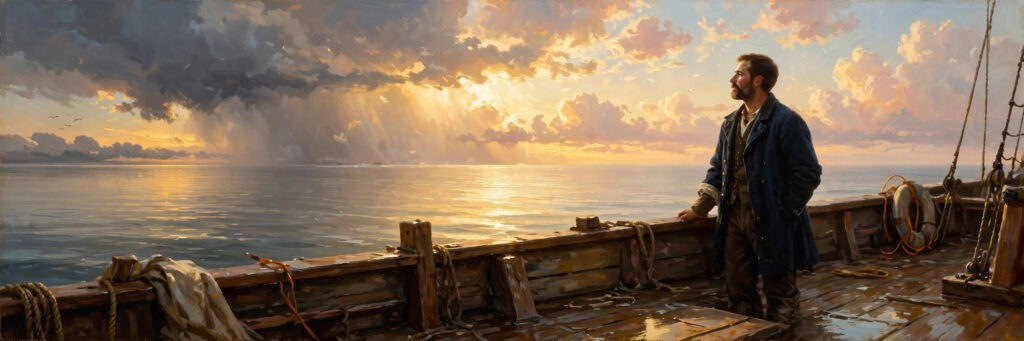
During the crossing, already on the high seas, the ship’s captain had Spafford called and delicately informed him that they were passing near the exact point where the Ville du Havre had sunk. Horatio remained gazing at those waters, the same immense sea that had taken his daughters, and there, in that place, he took paper and pen and wrote the poem the whole world would sing afterward.
Its first verses say: “When peace, like a river, attendeth my way, when sorrows like sea billows roll; whatever my lot, Thou hast taught me to say: it is well, it is well with my soul.” The poem does not deny the pain or disguise the loss: it speaks of sorrows like sea billows, the very image before his eyes. But it does not stop there either: its stanzas look to the cross of Christ and to the hope of his coming, and declare that neither tragedy nor death has the last word. With a broken heart, Spafford wrote that his soul was at peace.
The music of Philip Bliss
The poem reached the hands of Philip Paul Bliss, one of the most beloved hymn composers of his generation and a collaborator in Moody’s evangelistic campaigns. Bliss was deeply moved by the text and, in 1876, composed its melody. With a gesture full of meaning, he named it “Ville du Havre,” the name of the sunken ship, so that no one would forget from what pain those words were born. The hymn was published that same year in the hymnal Gospel Hymns No. 2 and began to be sung in the churches.
But Bliss’s story also ended in tragedy. On December 29, 1876, traveling by train with his wife Lucy toward Chicago, the Ashtabula bridge in Ohio collapsed and the cars fell into the void and caught fire. Bliss managed to get out alive from the wreckage, but upon realizing that Lucy was still trapped, he went back into the burning car to try to rescue her. Neither of them survived, and their bodies were never found. Bliss was 38 years old. The man who set peace amid pain to music died as he lived: giving himself out of love.
A hymn that never stops comforting
Horatio and Anna rebuilt their life in Chicago. Years later, in 1881, the Spaffords settled in Jerusalem, where Horatio died in 1888, far from the sea but close to the faith that had sustained him. His hymn, by contrast, never stopped traveling: it crossed languages, cultures, and generations, and keeps appearing in hymnals around the world.
In the Spanish-speaking world we sing it as “Estoy bien” and as “Tengo paz,” and today you can find it among the Christian praise songs that the church has treasured for more than a century, alongside the songs that remind us that faith is proven in the storm, not in the calm. Every time someone sings it at a funeral, beside a hospital bed, or on a night of tears, Spafford’s words do again the same thing they did in 1873: uphold a broken heart.
Perhaps that is why this hymn never grows old. They are not words of someone who did not suffer, but of a father who lost almost everything — his fortune, his four daughters, his peace of mind — and who, gazing at the sea that had taken it from him, decided to trust. The next time you sing it, remember where it was born: not on the safe shore, but over the deep waters, where a man with a heart in pieces could lift his gaze and say, with complete truth: “It is well, it is well with my soul.”
Leave a Reply