


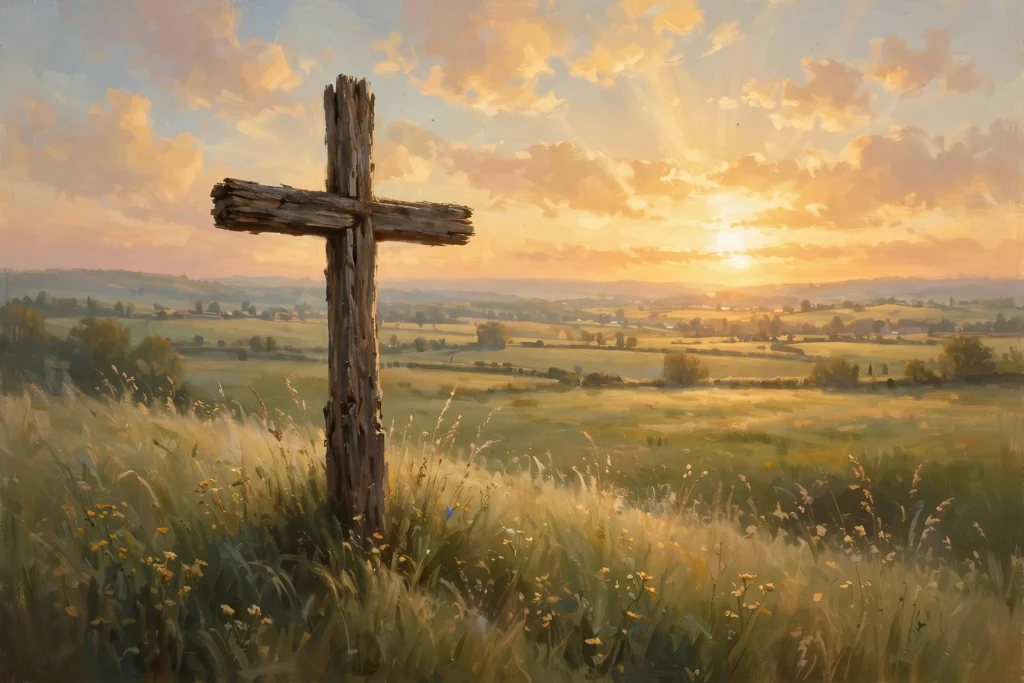
Fact sheet: Song: “The Old Rugged Cross” (“La vieja cruz”) · Author and composer: George Bennard (1873–1958) · Year: begun in 1912, finished in 1913, published in 1915

The context: a coal miner’s son who preached from town to town
George Bennard was born on February 4, 1873, in Youngstown, Ohio, the son of a coal miner. While still a boy, his family moved to Iowa, where his father worked in the mines. When George was sixteen, his father died in a mining accident, and the boy had to go down into the mine himself to support his mother and sisters. It was not an easy start: dust, danger and loss marked his youth before he could dream of a pulpit.
Soon after his father’s death, Bennard was converted at a Salvation Army meeting. He and his wife became officers of that organization, leading brigades, until they later moved to the Methodist Church. Ordained as a Methodist evangelist, Bennard travelled across the United States and Canada preaching at revival campaigns, many of them in Michigan and New York. He was not a preacher of great cathedrals or famous auditoriums: he was an itinerant evangelist, going from town to town, church to church, with his guitar and his message.
In those years, Bennard was making a special study of the cross in God’s plan of redemption. It was not a passing idea: the sources that record his life agree that he had spent time praying for a fuller understanding of the cross. He later described it with an image that became famous among those who studied his hymn: as he prayed to understand the cross, it seemed to him that he saw John 3:16 leaving the printed page, taking form, and acting out the meaning of redemption. Bennard was not looking to write a hit: he was looking to understand, for himself, what it really meant that Christ had died on a cross.
That search, however, was not moving as he hoped. In Albion, Michigan, where he had settled and opened his own hymn-publishing company, he began to compose a melody. The music came to him first, before the words. But the words would not come: for a time, all he had was a first line, “On a hill far away stood an old rugged cross,” and he could not get past it. The melody was in his heart; the lyrics were not yet there.
The turning point: mocked at a revival, he saw the cross in a new way
The turning point came in the middle of one of his campaigns, and it came not with applause but with mockery. While he was preaching at a revival meeting, some young people heckled him and mocked him in public. The sources do not dress the episode up with invented details: they say, simply, that it was a hard experience, a public humiliation in the middle of his preaching. But it was precisely there that something changed.
Bennard later said that, after that experience, he caught a new vision of the cross and began to see its deeper meaning. Seeing himself bearing, in a small way, the scorn of others, he pictured the Saviour leaving the city he loved so well, bearing the cross on which he would give his matchless life on the skull-shaped hill, for a sin-cursed and ruined world. The mockery did not turn him away from the cross: it drew him closer to it. And then, as the biographies of the hymn relate, the rest of the words began to flow freely.
He summed up the process years later with a disarming honesty that punctures any legend: “The inspiration came to me one day in 1913, when I was staying in Albion, Michigan. I began to write ‘The Old Rugged Cross.’ I composed the melody first. The words that I first wrote were imperfect. The words of the finished hymn were put into my heart in answer to my own need.” He spoke of no magical moment and no theatrical scene: he spoke of a need of his own, and of an answer that came as he meditated on the cross.
The hymn was finished during his revival travels. In Sturgeon Bay, Wisconsin, where he held meetings at the Friends Church between December 29, 1912, and January 12, 1913, together with Ed E. Mieras, Bennard and Mieras sang it as a duet on the last night, before a full house, with Pearl Torstensen Berg as organist. The well-known gospel-song composer Charles H. Gabriel later helped him with the harmonies. And the completed version was presented on June 7, 1913, in Pokagon, Michigan, at the First Methodist Episcopal Church, sung by a choir of five voices accompanied by guitar, from notes pencilled by Bennard himself. The pastor’s wife, Mrs. Bostwick, was so moved that she asked for the privilege of paying for the plates to print it. So a hymn that had begun with a single line and a melody without words finally reached the ears of a whole congregation.
The legacy: from a small church to the hymnals of the world
After Pokagon, the hymn was not long in leaving Michigan. Its first presentation outside that church was at the Chicago Evangelistic Institute, before a large convention, and it soon became extremely popular throughout the country. The great push came with Billy Sunday’s evangelistic campaigns: two members of his team, Homer Rodeheaver and Virginia Asher, made it popular in those crusades, and they are also named as the first to record it, in 1921. Bennard sold the rights to the Rodeheaver company; sources differ on the exact figure, between $50 and $500, but they agree on the essential point: the author did not grow rich from the most famous hymn of the twentieth century; the hymn grew rich in lives touched.
Formally published in 1915, “The Old Rugged Cross” came to be regarded, in general, as the most popular hymn of the twentieth century. A review written for its centenary recalled that by 1939 more than 15 million copies had been sold and numerous recordings made. Curiously, the major hymnals were slow to accept it — largely until the 1950s — in part because it expressed such direct affection for the cross itself, rather than for Christ, that some found it controversial. But congregations had adopted it long before the books did: they sang it in services, in campaigns, at funerals and in family gatherings, because it said simply what many felt and could not express.
Bennard composed about 300 more hymns, but none reached the fame of “The Old Rugged Cross.” He retired to Reed City, Michigan, where the town maintains a museum dedicated to his life and ministry, and near his home a cross almost four metres high was erected bearing the words “The Old Rugged Cross.” In Albion, a historical marker at the corner of Michigan Avenue and College Court recalls that the hymn was composed there in 1912. And in Youngstown, his birthplace, a memorial at Lake Park Cemetery honours his memory.
Today, more than a century later, the hymn keeps ministering wherever it is sung. Not because the cross is a pretty symbol, but because it keeps pointing to the same thing Bennard discovered when he was mocked at that revival: that the scorn of the world does not have the last word, and that in the old, rugged cross there are forgiveness, hope and, at the end of the road, a crown that replaces the cross. Bennard wrote the hymn to answer his own need, and that need turned out to be the need of millions.
A verse to connect with
“For God so loved the world, that he gave his only begotten Son, that whosoever believeth in him should not perish, but have everlasting life” (John 3:16). That was the verse Bennard was meditating on while the song took shape, and it remains the heart of his message: God’s love, given on the cross, for all who believe.
Listen to the song
If you would like to hear it again with your heart set on that story, you can do so among the songs of Michael W. Smith: his version of “The Old Rugged Cross” sounds today just as deep as the day Bennard first sang it in Pokagon.
Leave a Reply